Cursed Blood, Hollow Halls: The Gothic Foundling and America's Terror of Uncertain Origins
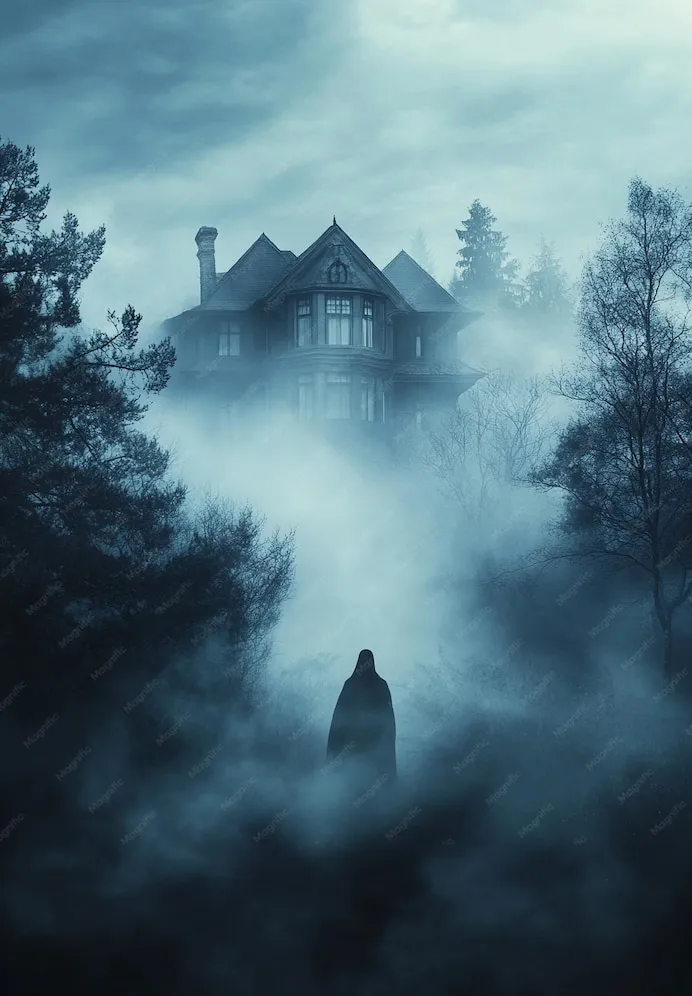
Photo: dark gothic abandoned mansion fog mysterious child silhouette, via img.freepik.com
There is a particular species of dread native to American Gothic literature, one that has nothing to do with ghosts in the conventional sense. It does not rattle chains or drift through moonlit corridors. Instead, it arrives at the front door clutching a birth record with a line left blank — and the horror is that no one in the household can agree on what should fill it. The foundling, the bastard, the child of uncertain parentage: these figures haunted the American literary imagination long before Stephen King made rural Maine synonymous with the uncanny. They were present at the republic's literary founding, and they have never truly left.
To understand why parentlessness became so thoroughly intertwined with Gothic terror in the American tradition, one must first reckon with what the Gothic mode was built to do. Where European Gothic literature obsessed over decaying aristocratic bloodlines and the sins of old-world dynasties, American Gothic writers were grappling with something simultaneously older and more urgent: the question of whether a nation that had violently severed itself from its own origins could ever truly know what it had become.
Hawthorne and the Stain That Cannot Be Washed
Nathaniel Hawthorne understood this anxiety with a precision that bordered on the pathological. His own family history — he quietly inserted a w into the spelling of his surname to distance himself from his ancestor John Hathorne, a judge at the Salem witch trials — made him personally acquainted with the burden of inherited identity. In The Scarlet Letter (1850), the child Pearl is not precisely an orphan, but she functions as one in every meaningful cultural sense: she is a child whose legitimate origins are publicly erased, whose father is a secret, and whose very existence is read by Puritan society as a living symbol of transgression. Pearl's wildness, her refusal to be domesticated, her unsettling perceptiveness — Hawthorne codes all of it as the natural consequence of illegitimacy. She is, in the eyes of her community, a creature born outside the covenant, and therefore outside the protections that covenant affords.
What makes Hawthorne's treatment so resonant for the Gothic tradition is his insistence that the stain is not merely social but metaphysical. The sin that produced Pearl does not belong to Hester alone; it radiates outward, warping the moral landscape of an entire community. The foundling, in this reading, is not simply an individual without a past — she is a rupture in the fabric of institutional legitimacy itself. Her existence forces the question that every Gothic narrative eventually asks: what happens when the structures we trust to verify identity and bestow belonging are revealed to be corrupt, or simply insufficient?
The Southern Gothic and the Sins Buried in the Soil
If Hawthorne planted the seed, Southern Gothic writers cultivated it into something far more grotesque. William Faulkner's fictional Yoknapatawpha County is populated by characters whose uncertain origins serve as the engine of tragedy. Joe Christmas, in Light in August (1932), is a foundling whose racial identity is ambiguous — and it is precisely that ambiguity, that blank space where parentage should provide certainty, that marks him for destruction. Faulkner understood that in the post-Reconstruction South, the question of blood purity was not merely personal but political, and that the child who could not prove his lineage was a walking indictment of the entire system that claimed to organize human worth along biological lines.
Flannery O'Connor, writing a generation later, took a different but equally unsettling approach. Her orphaned and abandoned characters — the misfit children, the spiritually homeless adults — are foundlings in a theological sense. They have been severed not only from family but from grace, and their violence and grotesquerie are presented as the natural fruit of that severance. For O'Connor, the child without origins is the child without redemption, at least until some shattering moment of divine intrusion forces a reckoning.
The 20th Century and the Institutionalized Horror
As the twentieth century progressed, American Gothic literature began to shift its focus from the metaphysical corruption of uncertain blood to something arguably more terrifying: the corruption of the institutions designed to manage it. Orphanages, asylums, foster homes, and adoption agencies became the new haunted houses, and the children cycling through them became the new Gothic foundlings.
This shift reflects a broader cultural disillusionment. The Progressive Era had promised that rational, benevolent institutions could solve the problem of the abandoned child. By mid-century, it was becoming apparent that these institutions had their own appetites, their own secrets, their own capacity for cruelty. Writers like Joyce Carol Oates — whose Gothic sensibility has always been attuned to the violence lurking beneath respectable American surfaces — returned repeatedly to the figure of the child displaced from family and community, examining how institutional frameworks replicate and often intensify the original trauma of abandonment.
In contemporary horror, this institutionalized Gothic has found its fullest expression. The haunted orphanage is now a genre staple, but the most sophisticated iterations of the trope use the setting not merely for atmosphere but for critique. The horror is not that the building is haunted; it is that the building was always a site of power over the powerless, and that the ghosts it generates are the inevitable product of that arrangement.
What the Foundling Reveals
The persistence of the cursed foundling in American Gothic literature is not accidental, and it is not simply a matter of narrative convenience. This figure has endured because it performs a specific cultural function: it externalizes the anxieties that a nation built on ideals of self-invention and institutional legitimacy cannot otherwise bring itself to examine directly.
To be a foundling in the American Gothic is to be the living proof that origins matter, that the blank space in the record does not disappear simply because it is inconvenient. It is to embody the possibility that the institutions tasked with assigning identity and conferring belonging are fallible, or worse, that they are instruments of a social order that has always been more interested in maintaining its own coherence than in honoring the complexity of actual human lives.
The cursed foundling, in other words, is not a monster. It is a mirror. And what it reflects — the terror of uncertain origins, the violence of institutional failure, the haunting persistence of what has been deliberately left unnamed — remains as legible in contemporary American culture as it was in Hawthorne's Boston. The hollow halls are still full. The blood is still uncertain. And the horror, as it has always been, is that we built the house this way on purpose.